
The Real Cost of Reaching Your Fitness Goals
The charts on this page illustrate the real cost of pursuing fitness goals with & without a system in place - time lost, money wasted, inconsistent results, and preventable setbacks.
Professional coaching shouldn’t be viewed as an added expense; a system designed to reduce inefficiency, eliminate guesswork, and produce outcomes with fewer wasted resources - ultimately returns time that can be redirected toward higher-value priorities.
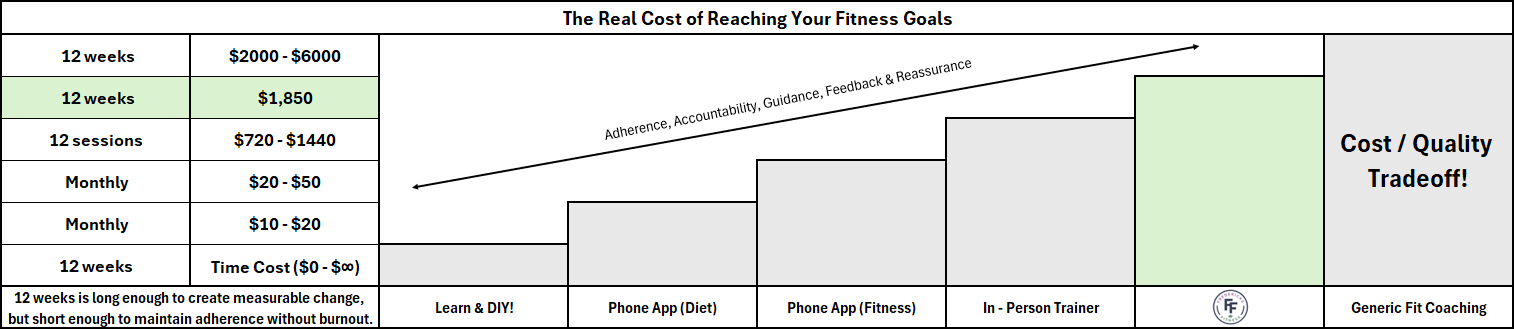
Lower cost options reduce financial commitment—but also reduce guidance, feedback, and accountability.
As price increases, perceived value often rises due to increased access to support and personalization. However, higher price alone does not guarantee higher outcomes.
This comparison highlights where value is gained, where it plateaus, and where inefficiencies re-emerge despite increased cost.
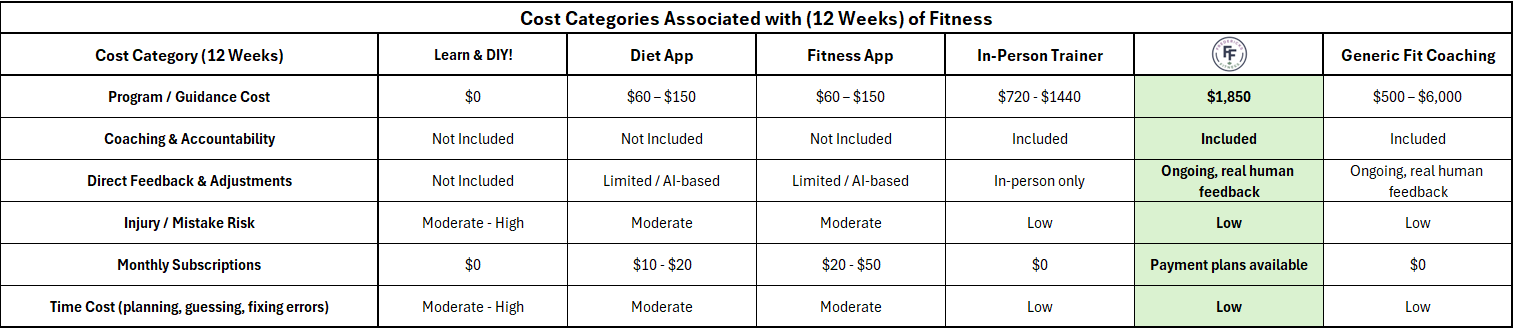
This comparison outlines the visible and hidden costs associated with different fitness approaches over a 12-week period.
While lower-cost options minimize upfront spending, they shift responsibility for planning, error correction, and adherence onto the individual - often increasing time cost, inconsistency, and risk.
Higher-cost options increase access to guidance, but outcomes depend on how effectively that guidance is delivered, applied, and sustained beyond isolated sessions.
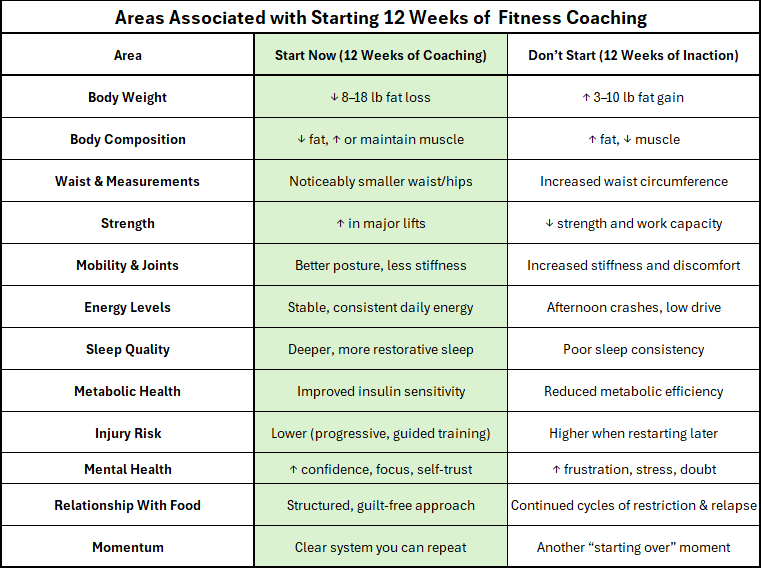
There is no single “right” way to pursue fitness - only different ways to pay for it.
Every option shown on this page represents a trade-off between money, time, effort, uncertainty, and risk. The outcomes are not determined by the category chosen, but by how efficiently that category converts effort into results.
For some, the real cost of fitness is paid in dollars. For others, it is paid in delays, frustration, stalled progress, or repeated restarts.